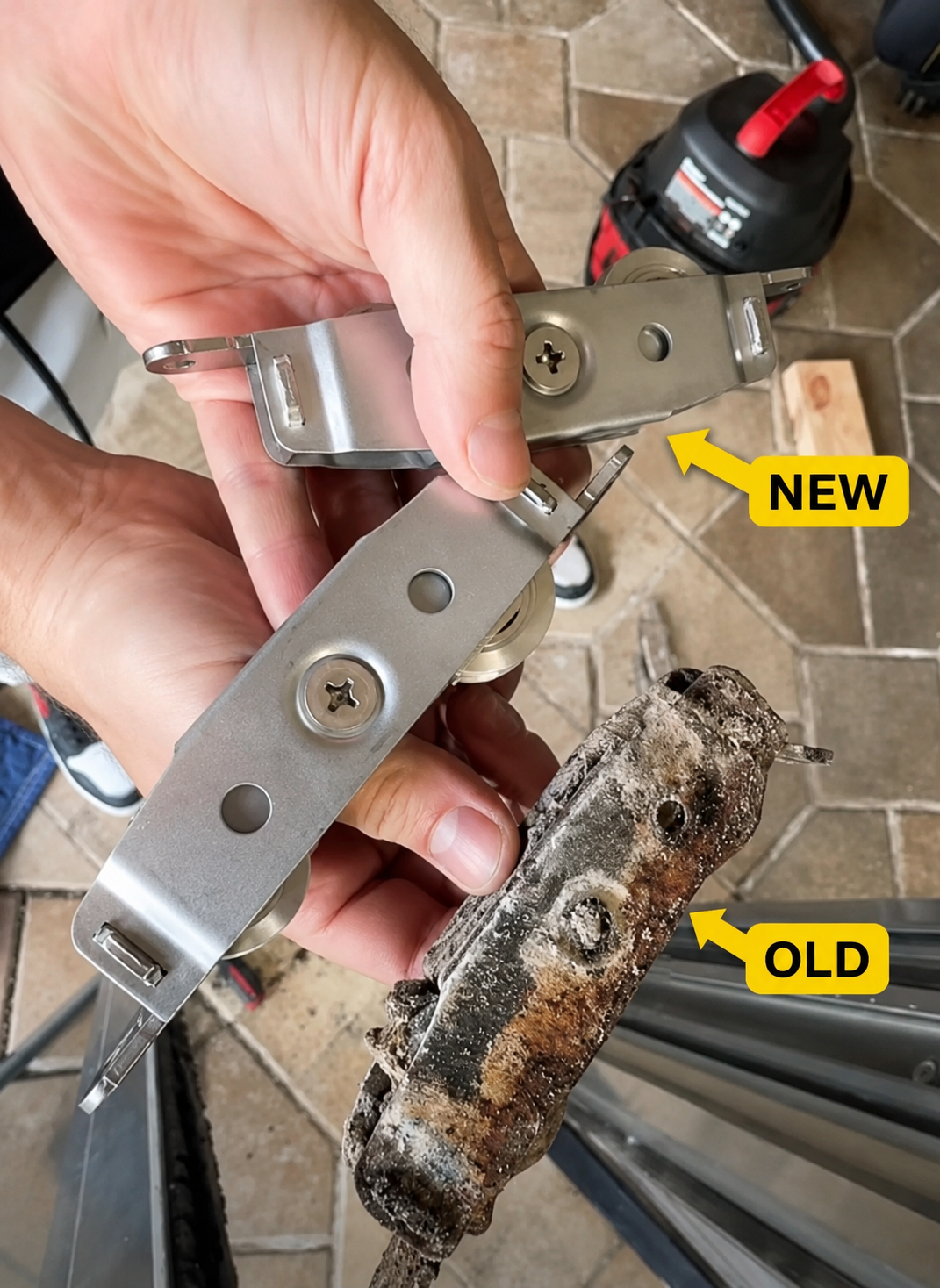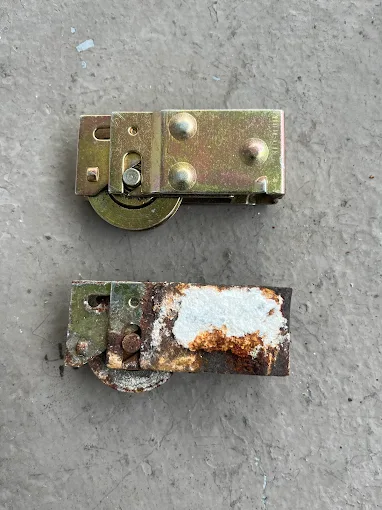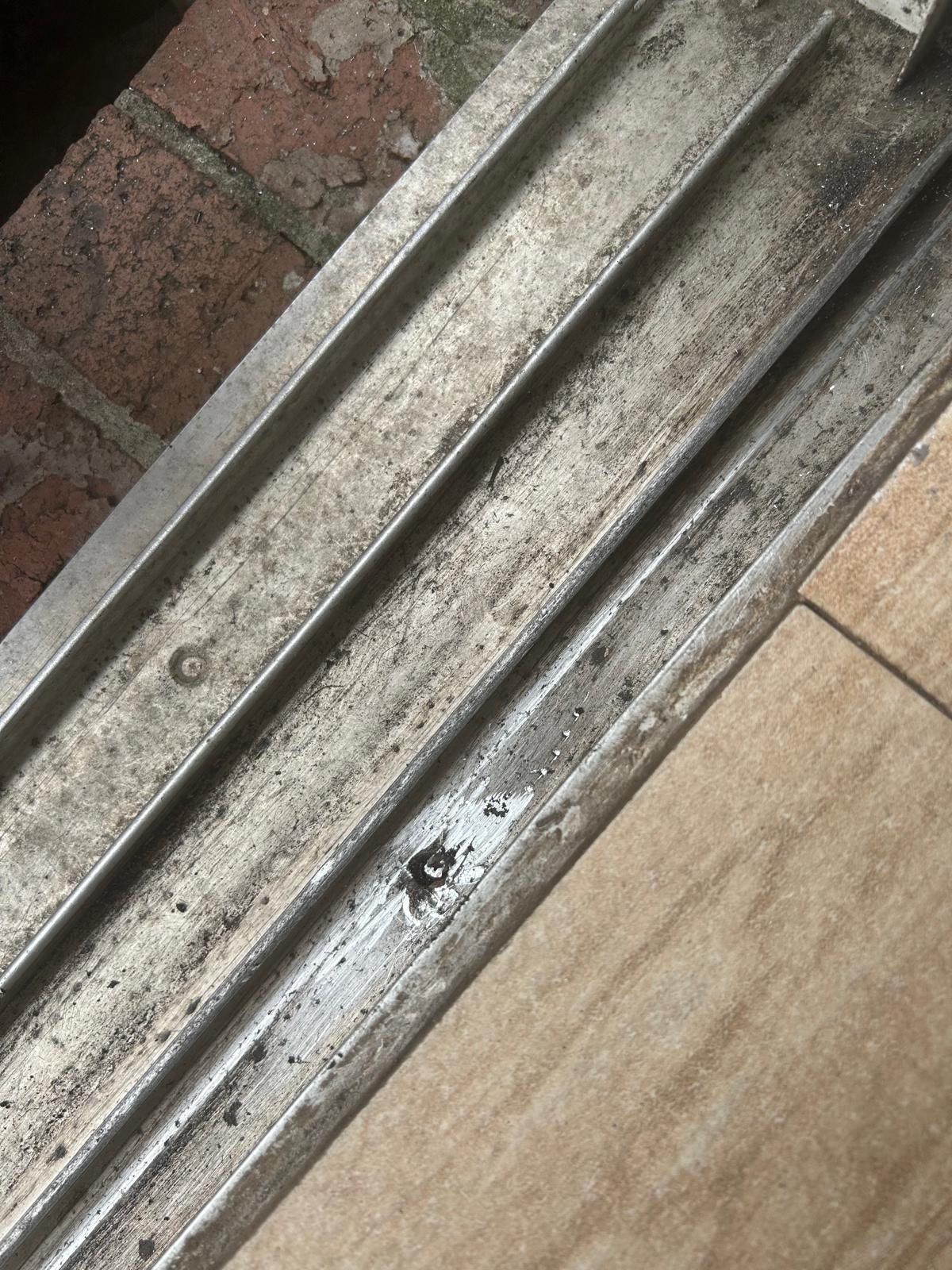
A bump at a repeatable point calls for inspecting that part of the wheel-running path for debris, a dent, a raised joint or wear. Recurring gray residue is another observation, not proof of a failed roller. Remove only accessible loose contamination gently, then record any remaining catch without hammering or reshaping the rail.
Locate the problem without forcing movement
Observe the affected area only if the panel is stable and the glass intact. Note the position where ordinary travel becomes rough, then photograph the accessible rail there.
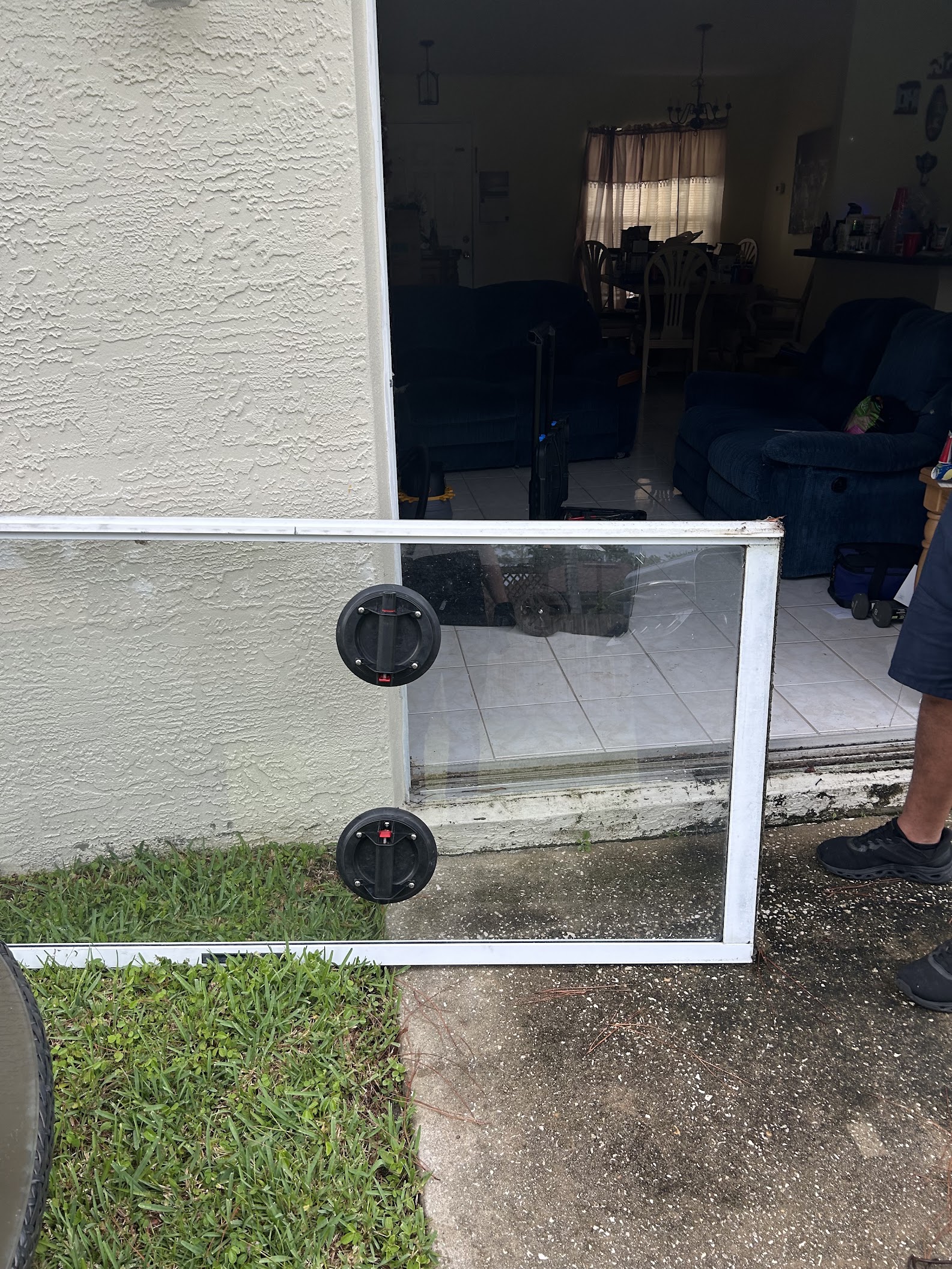
Use a wider photo to show which track and panel are involved. A close-up of a ridge can be difficult to interpret without that context.
If the panel rocks or requires a shove over the point, stop testing it. The symptom has already provided enough information to request inspection.
Distinguish dirt from a physical irregularity
Loose grit may create localized resistance and can sometimes be removed using gentle compatible cleaning. A dent or worn groove remains after debris is removed.
| Finding after careful cleaning | What to ask |
|---|---|
| The bump disappears | Was contamination the only observed problem? |
| A visible defect remains at the same location | Can the intended running profile be restored appropriately? |
| Roughness repeats throughout travel | Are the wheels or bearings also damaged? |
| Resistance appears at a repair joint | Are transitions and fit suitable? |
| One panel behaves differently from another | Do they use the same rail and hardware relationship? |
Do not scrape, hammer or grind the ridge before its profile and support are understood.
Gray residue deserves context
Fine gray dust can be ordinary contamination. It can also accompany wear from a wheel, rail or dragging component. Its presence alone does not establish which material is being lost.
Clean a reachable area using approved care methods, then note how quickly residue returns. Record whether it collects around a fixed defect or follows broader travel.
A technician should inspect the actual contact surfaces. Repeated residue paired with scraping or increasing effort is more informative than color alone.
Assess repair joints and previous modifications
A cap, insert or other earlier repair may create a transition the wheel must cross. Fit, support and resulting running height affect the outcome.
Ask whether a new bump began immediately after work. That history helps distinguish new wear from an unsuitable joint or changed geometry.
The solution should address the cause. Adding another layer without checking clearance, attachment and drainage can create additional complications.
Match track work with roller condition
A repaired rail still needs appropriate wheels. A damaged wheel may continue producing noise or damage after the local defect is corrected.
Conversely, new rollers may still bump over the same rail irregularity. A useful proposal should explain whether both components need attention and why.
For track restoration at a Green Cove Springs property, send the defect's location and note any previous track work.
Evaluate the crossing after repair
Move the panel through its normal usable range in both directions. Check the repaired location and any joints introduced by the work.
The result should not depend on momentum carrying the door over a raised point. Also confirm stable panel support and natural lock engagement.
Separate the panel's stopping point from the rail defect
Note where the panel is when the catch occurs, then photograph any reachable defect in the running ridge. Include a wide image so the crew can locate the rail and affected panel. Different wheel assemblies may cross one defect at different panel positions, so one mark can be associated with more than one interruption.
After gentle cleaning, record whether residue returns at the same area or across broader travel. That pattern helps an inspection without identifying the material source by color alone.
If track work is recommended, use the restoration-versus-cap guide to ask about profile, support, joints and the effect on panel height.
Reference: Truth side-adjust tandem roller specifications. Wheel design and rail contact matter; a catalog reference does not identify the source of gray residue.
Localized-bump questions
Can a tiny dent cause a noticeable catch?
Yes. The loaded wheel meets a narrow running surface, so small changes can affect movement. The appropriate repair depends on the actual profile and support.
Does gray dust prove I need new rollers?
No. Identify the source of wear or contamination before selecting parts.
Should a track cap always eliminate a bump?
Only an appropriate repair can be expected to address the identified defect. An unsuitable profile, weak base or abrupt joint can create its own problem.
Ask Sliding Doors Masters to evaluate the fixed catch. Include your ZIP, a wide opening photo and the defect's location. Mention returning residue and any previous cap or insert without modifying the ridge before inspection.
Need this looked at on your own door? Get a free estimate or talk it through with our team.
Related service