Use the lubricant specified for your door's particular component, after cleaning as directed. Some hardware permits a compatible dry product; some bearings are sealed or permanently lubricated. There is no single spray recommendation for every track, lock, seal and bearing. Persistent grinding or repeated short-lived improvement needs a mechanical inspection.
A door is not one lubrication point
The roller wheel contacts a running surface. Inside the assembly, a bearing may already contain protected lubricant. The lock has its own moving components and finish. Weatherstripping is another material with different compatibility requirements.
Spraying the entire threshold until it is wet treats all those components as though they were interchangeable. It can leave residue where sand, hair and household dust collect.
The goal is appropriate maintenance, not the largest quantity of spray.
Product instructions can differ
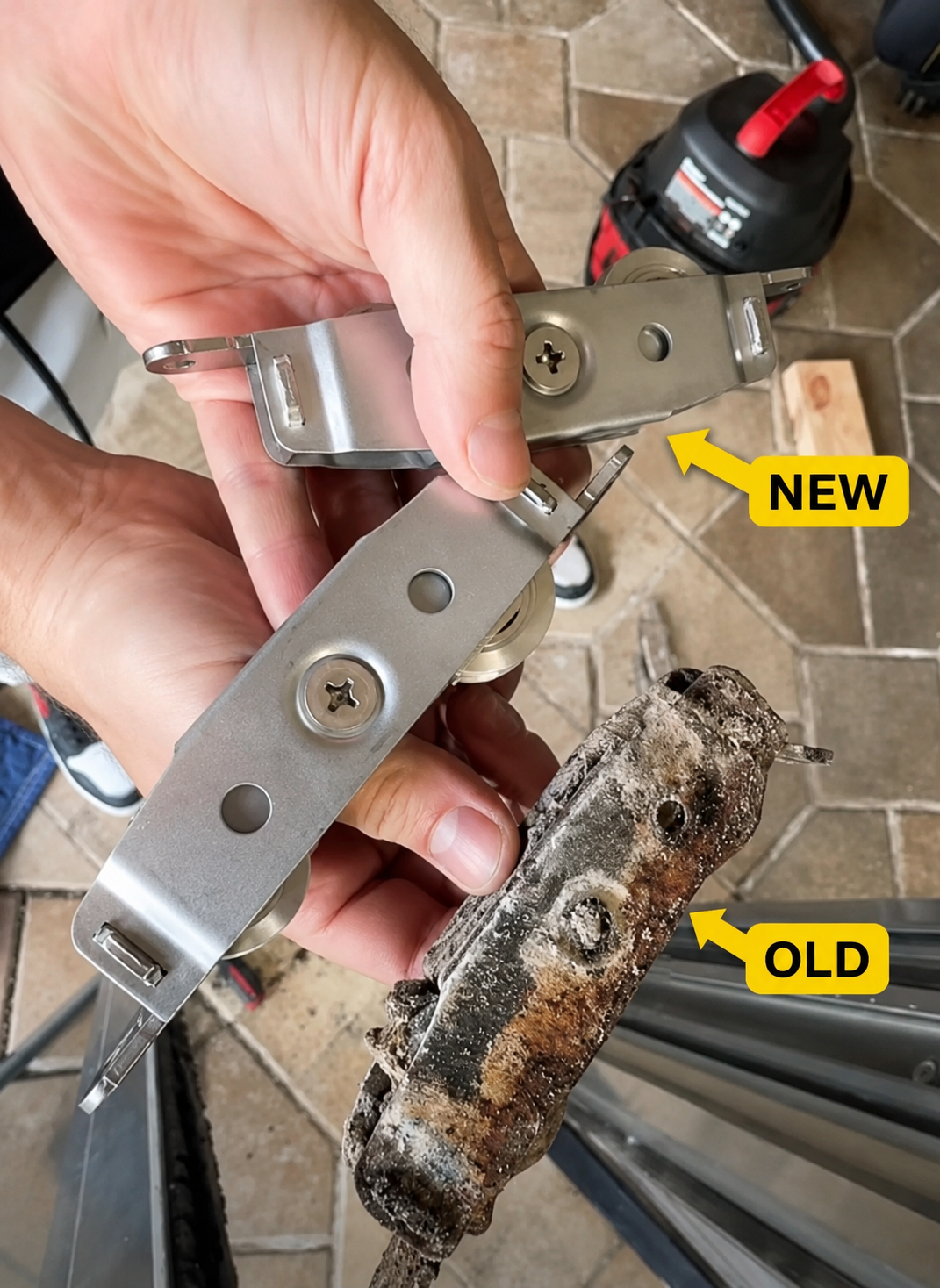
Andersen publishes guidance for compatible dry lubricant on certain moving hardware. Some roller families, such as Truth's end-adjust tandem designs, use permanently lubricated protected bearings.
PGT/MITER's broad care guide contains both sealed-bearing information and general lubrication guidance. That is a reason to confirm the exact application, not to assume every sentence describes every door.
If instructions appear inconsistent, use the model-specific manual or ask the manufacturer or servicing professional to clarify which component and product are intended.
| Component or condition | Sensible first action |
|---|---|
| Accessible dirty wheel path | Remove debris using compatible cleaning |
| Sealed or protected bearing | Confirm its specified care; do not inject product blindly |
| Stiff lock | Check engagement and alignment before selecting lubricant |
| Damaged seal or plastic guide | Verify material compatibility and inspect the damaged part |
| Grinding that returns immediately | Investigate mechanical wear |
Read the label beyond the brand name
A familiar brand can sell penetrating products, dry-film sprays and other formulations. Those are not automatically equivalent.
Check the specific formulation, permitted materials and application instructions. Solvents can affect a finish or plastic even if the product is advertised for mechanical use. A product's popularity does not establish approval for your patio door.
If an old service left unknown sticky residue, identify a compatible cleaning approach before adding another product over it.
Lubricant cannot restore missing material
A flattened wheel, broken housing, pitted rail or misaligned panel needs a mechanical explanation. A spray cannot put worn metal back onto a track or make an incompatible replacement fit correctly.
Temporary improvement is still useful information. Note how long it lasts and whether effort, noise or lock behavior changes. Share that history rather than repeatedly applying more product.
If the door becomes unstable or starts leaving its path, stop operating it. Maintenance advice for a stable system does not make a damaged panel safe.
Ask for instructions after repair
When parts change, care requirements may change too. Ask which areas to clean, which component needs an approved product and whether the new bearings require homeowner lubrication at all.
Keep the part description and care information with your repair record. For door maintenance at a Jacksonville Beach property, contamination and salt exposure can justify closer observation, but they do not override manufacturer guidance.
Ask for a maintenance answer you can repeat correctly
A useful instruction identifies the component, the exact type of permitted product and its application method. "Spray the door" leaves too much unexplained. Ask the technician to point out the intended location and distinguish it from surfaces that only need cleaning.
If a new roller assembly has protected bearings, record that fact with the part description. Do not assume the old owner's lubrication routine applies to the replacement.
For a Jacksonville patio that collects sand, cleaning frequency and product selection are separate decisions. More exposure may call for closer care; it does not authorize an incompatible formulation. The track-cleaning article provides the safe accessible first step.
Reference: Andersen hardware cleaning and lubrication guidance. These instructions identify compatible dry lubrication for covered hardware; exact product and component applicability matter.
Lubrication questions
Is every silicone spray suitable for a sliding door?
No. Formulation, solvents, materials and the specific application matter. Use a compatible product permitted by the relevant instructions.
Is every product sold under the WD-40 name oily?
No. A brand includes different products. Check the exact product rather than making a decision from the brand name alone.
Can I lubricate a lock that binds only when the door is closed?
Check panel and keeper alignment first. Resistance caused by misalignment can remain after lubrication and may place unnecessary load on the handle or mechanism.
Ask for a door maintenance evaluation if lubricant has become a recurring workaround. Tell Sliding Doors Masters which product was used, where it was applied and how long any improvement lasted.
Need this looked at on your own door? Get a free estimate or talk it through with our team.
Related service