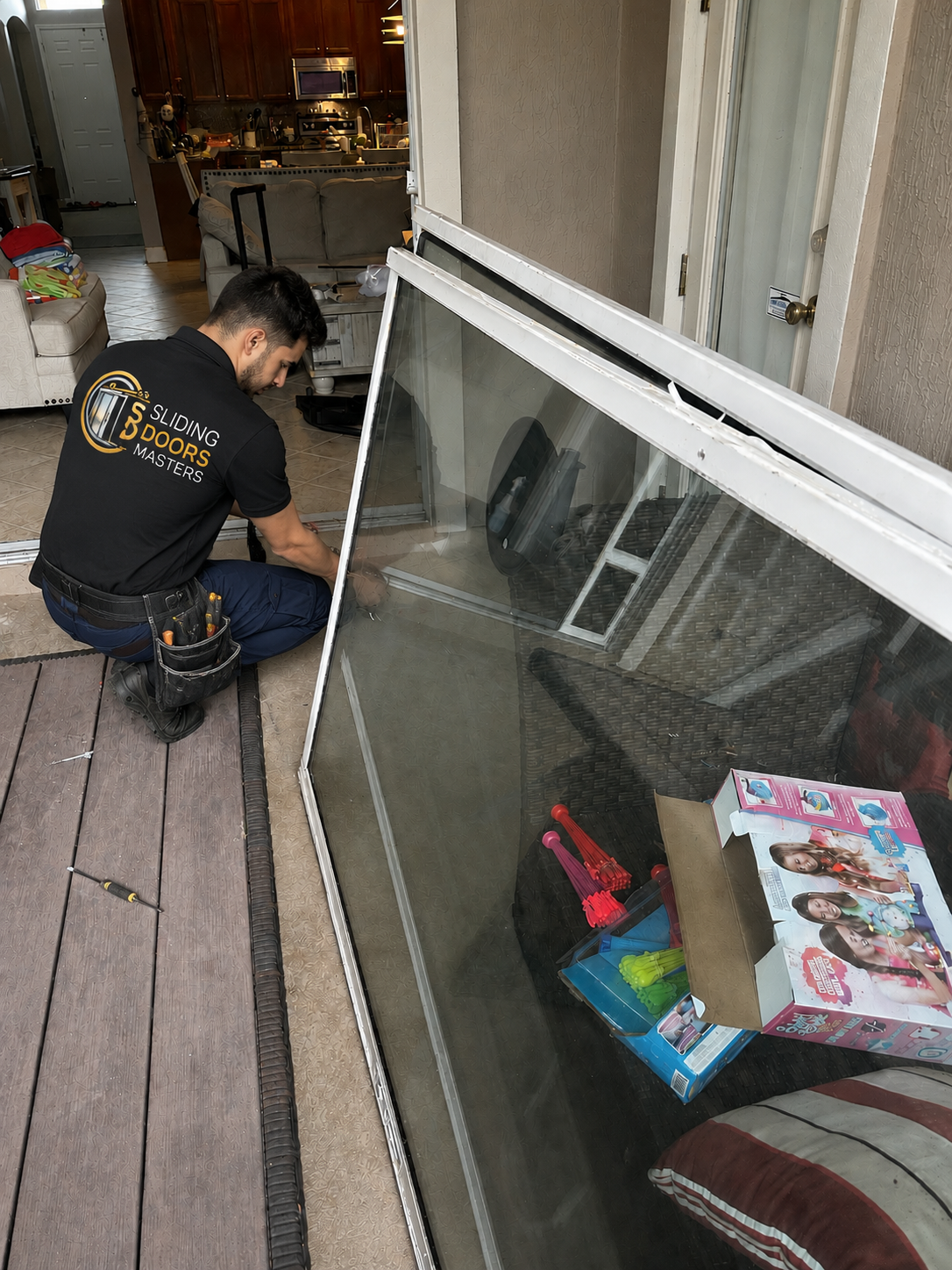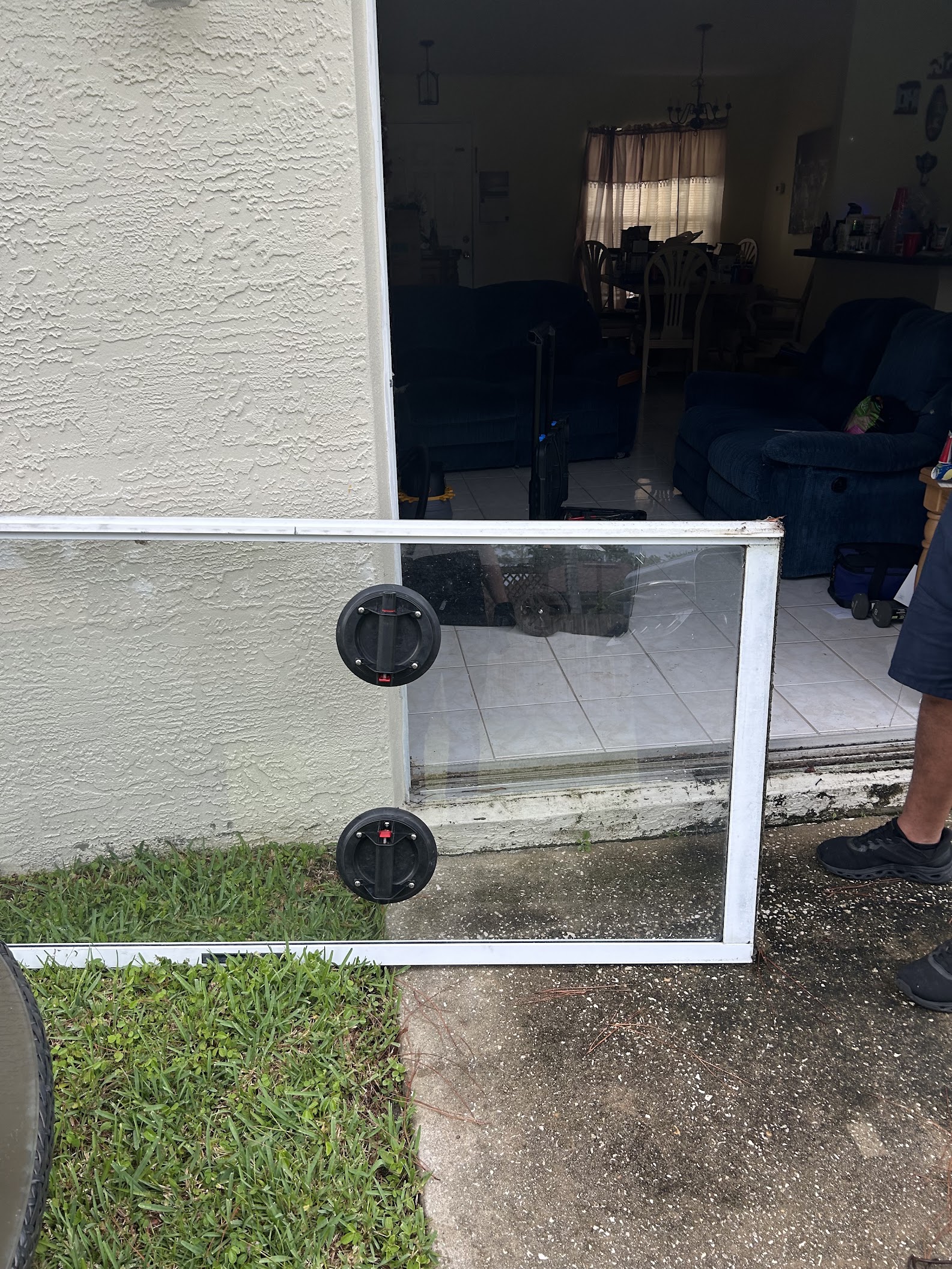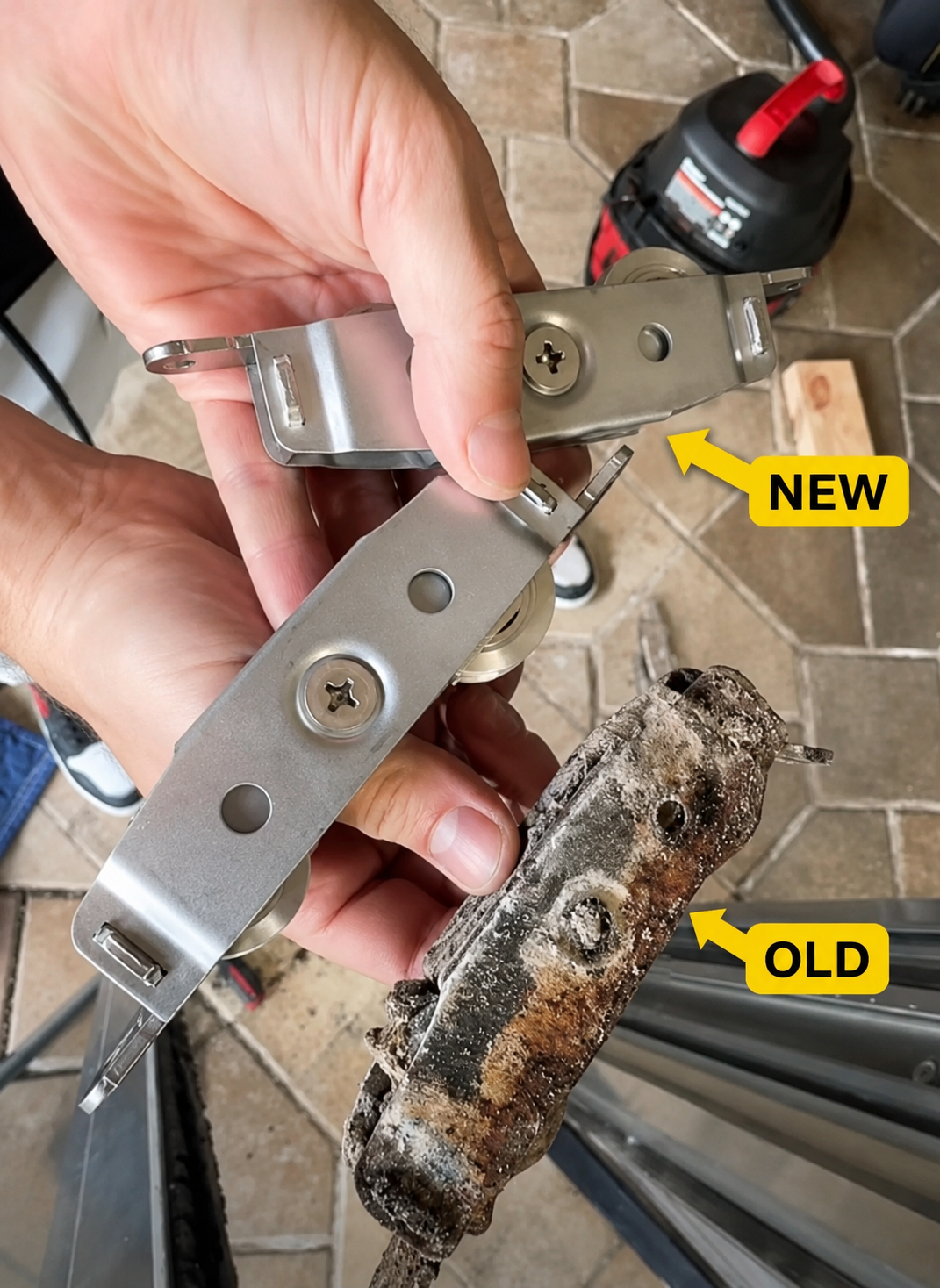
For an intact, stable door, start by vacuuming loose grit and brushing reachable corners gently. Wipe with the cleaner and moisture level permitted for the product, then remove residue and dry accessible surfaces. Preserve seals and drainage passages. If the same grinding, tilt or fixed bump remains, cleaning has supplied a useful observation rather than a complete repair.
Start with a safe, accessible work area
Use another opening if the panel rocks, has left its path or contains cracked glass. Cleaning is not the first step for an unstable door.
For a stable panel, expose a reachable section of track without forcing movement. Keep children and pets away from the work area. Do not remove a heavy glass panel to reach a dirty corner.
Useful supplies usually include a vacuum with a narrow attachment, a soft brush, soft cloths and the gentle cleaner allowed by the door's manufacturer. Keep a dry cloth nearby.
Remove loose grit before wiping
Vacuum loose sand, dust and pet hair from the accessible channel. Use the soft brush to loosen material around corners without scraping the finish or pushing debris into hidden openings.
Work in small sections. Dry grit dragged beneath a cloth can scratch a finished surface, so remove loose particles before wiping more firmly.
If you find metal fragments, recurring gray residue or a damaged ridge, photograph the area. Debris can explain some resistance while mechanical wear explains the rest.
Use modest moisture and a compatible cleaner
Dampen a cloth rather than filling the threshold with liquid. Wipe the accessible surfaces with the manufacturer's approved cleaning method, then remove residue and dry what you can reach.
Avoid assuming that a product suitable for bathroom tile is suitable for a patio door. Strong acids, abrasives or incompatible solvents can harm finishes, coatings and seals. “Natural” is not a compatibility specification either.
Do not use a pressure washer to flush the system. Forceful water can reach areas that are not intended to be cleaned that way.
Treat drainage openings as drainage openings
Many thresholds include designed passages that allow collected water to leave toward the exterior. Keep reachable openings clear using the product's care instructions.
Do not fill a suspicious slot with caulk just because it looks like a gap. Do not enlarge drainage holes or push tools through unseen passages. A clogged accessible opening and a concealed installation defect require different solutions.
If exterior access would require reaching beyond a balcony or working from a ladder, leave that portion for an appropriate professional.
Evaluate the result without overtesting
| After cleaning | What it suggests |
|---|---|
| Movement improves and remains stable | Contamination was likely contributing |
| The same bump occurs at the same point | Inspect the rail for a localized defect |
| Grinding persists through travel | Inspect rollers and rubbing components |
| The panel remains low or tilted | Investigate support and alignment |
| Water repeatedly enters the room | Diagnose drainage and installation separately |
One cleaning does not establish a precise diagnosis, but it gives you a useful before-and-after observation.
In Mandarin or another Jacksonville neighborhood, the right routine depends on your patio, pets and exposure. For persistent resistance, a door tune-up should include inspection rather than cleaning alone.
Make one cleaning check useful for the next decision
Before cleaning, note where resistance occurs and take a photo of the reachable running surface. After cleaning, compare ordinary movement only if the panel remains stable. Keep the comparison simple: better throughout travel, unchanged at one spot, or still rough everywhere.
That small record prevents two common mistakes: assuming every improvement proves the wheels are healthy, and assuming a stubborn mark just needs a stronger cleaner. You have removed one variable without changing the rail's shape.
If the door improves and stays consistent, continue the product's routine care. If it still catches at one location, use the localized-bump guide to describe the remaining condition.
Reference: PGT/MITER care and maintenance guide. Covered products need compatible gentle cleaning and preservation of their designed drainage features.
Cleaning questions
Can I use a metal scraper on packed dirt?
Avoid scraping finished door surfaces or seals with a sharp tool. Start with gentle compatible cleaning, and ask for help if material cannot be removed without damaging the product.
Should I spray lubricant immediately afterward?
Only where the exact door and hardware instructions call for it. A clean track and a lubricated component are different maintenance tasks.
How do I know cleaning has not solved the problem?
Persistent grinding, tilting, scraping or a recurring fixed bump are reasons to inspect the mechanics. Do not keep increasing force to judge the improvement.
Request service if cleaning leaves a persistent symptom. Tell Sliding Doors Masters what improved, what remained and where it happens. Include your ZIP; leave the panel and track profile intact for inspection.
Need this looked at on your own door? Get a free estimate or talk it through with our team.
Related service